My Cart
0 Items

*Get Extra 5% Off on Prepaid Orders*
*Cash on Delivery Available*
*Pan India Free Shipping On & Above Rs.649*

Connect with us +91-7995798881



Did you know that by 2025, the ghee market can reach £6.1 billion worldwide! Desi Cow Ghee's increasing popularity by its potential health advantages. Is Cow ghee that good, as everyone says? We shall look into the science to decide what Cow Ghee does to your health. Key Notes Indian Cuisine has been utilising Cow ghee or clarified butter for centuries. With its high amounts of antioxidants, vitamins, and healthy fats in Pure Desi Ghee, it is nutritional addition to any diet. Some studies present the view that Cow Ghee may be beneficial for digestion, heart health, and also inflammation. Due to the high calories in clarified butter, it should be used in moderation with a balanced and nutritious diet. The Bilona process is believed to be one of the traditional ghee-making processes and has been thought to bring about improvements in the nutritional profile of the product. Unmasking the Truth about A2 Cow Ghee Desi Cow Ghee, the golden wonder of Indian cooking, has many numerous benefits and is considered as a healthy elixir. In what ways does Desi Cow ghee vary from butter? By examining how ghee is utilized in Indian cuisine, one will gain a better understanding of this product. What is Desi Cow Ghee (A2)? How is it different from Butter? One kind of clarified butter is Ghee. It is made by heating ordinary butter to remove its milk solids and water content. This leaves ghee as a rich, nutty-flavoured fat that is less prone to oxidation. It also contains a higher smoke point compared to butter. This makes it ideal for high-temperature cooking. In India, traditionally extracted ghee in a 'Bilona' process first required the churning of cream by hand to get the butter and then it's simmering. It helps retain the real taste and goodness of pure ghee. Knowing the Traditional Usage of Cow Ghee in Indian Cuisine Indian kitchens have traditionally included Cow Ghee as a key ingredient. From curries to sweets to religious rites, it finds one or other way. Its peculiar flavour and aroma add magic to Indian cuisine. From the traditional variety Bilona Ghee to the best Desi and organic types in India, this Cow Ghee is considered a treasure. It reflected the rich food culture and tradition of India. The typical use of A2 Cow Ghee in Indian cooking, especially the Bilona method, has crossed boundaries. Be it the best Desi Ghee, Bilona Ghee, or Organic ghee in India, history and benefits have made pure ghee a ‘Sine Qua Non’ in every kitchen. Is Desi Cow Ghee really that Good for You? There has been much discussion on the health benefits of Desi Cow Ghee. It's considered a superfood with many medicinal properties by some. Others think it has any nutritional significance. Let's go by science and how good ghee is. Cardiovascular Health Ghee is supposed to keep your heart healthy. The special fats in Desi Cow Ghee include CLA and butyrate, which may help with cholesterol and decrease inflammation. However, we would like more studies for confirmation, and ghee consumption must be in moderation. Weight Management Some claim that Desi Cow ghee is beneficial for weight loss or control. CLA in Desi Cow Ghee might influence fat metabolism; however, results are inconsistent. A2 Cow Ghee is high in calories and hence should be consumed judiciously, keeping in mind its contribution to one's overall diet if benefits are to be incurred as regards weight. Healing Properties A2 Cow Ghee plays a major role in Ayurveda from ancient days. This main Key ingredient has been used to treat a wide range of health disorders, from indigestion to skin issues. However, scientific data supporting these indications is scant, and further studies are required. In short, Desi Cow Ghee is widely debated, whether it is good for health or not. Some studies indicate benefits, but more proof is still required. The best thing is to add A2 Cow Ghee in moderation as part of your diet chart. Always, consult the doctor before making changes in your regular diet. Nutritional Value per 100g of Desi Cow Ghee Nutritional Profile Desi Cow Ghee (Clarified Butter) is originating from India and loved by all health lovers around the globe. It is a pack of special components of healthy fats, vitamins, and compounds that are good for health. Fat Composition Desi Cow Ghee is high in healthy fats, specifically monounsaturated and saturated fats. The major contents in the fatty composition of clarified butter include saturated fat, followed by monounsaturated fat and a little polyunsaturated fat. Hence, it is good to include Cow ghee in your regular diet. Vitamins, Minerals, and other Beneficial Compounds Bilona Cow Ghee also contains vitamins and minerals equally which help to support your overall growth. As it has vitamins A, D, E, and K, while minerals are calcium, phosphorus, and butyric acid. Hence, Ghee helps to strengthen bones, and best suitable for lactose intolerance people as well. FAQs What is the distinction between any type of ghee and butter? Unlike ordinary butter, ghee is clarified butter. This means it is always simmered to remove water content and milk solids. What is left behind is golden, rich butterfat that has a higher smoke point, along with a deeper flavour. What are the advantages of regularly consuming Desi Cow Ghee? Pure Desi Cow Ghee is a great source of healthy fats by the name of CLA and omega-3 fatty acids. It is heart-friendly as it prevents weight-gain and combats the inflammation caused by bad pathogens. Similarly, vitamins A, D, E, and K are also present in Bilona processed Ghee to help generally in one's health. But moderation is important. Is Desi Cow Ghee lactose-free? Well, Cow ghee is mostly lactose-free, since the milk solids are taken out in the process of its clarification (Bilona method). Hence, it is very suitable for people suffering from lactose intolerance or on a diet devoid of dairy products. How will the application of Cow Ghee be reflected in one's everyday life? In cooking, Desi Ghee is good for sautéing, stir-frying, and roasting vegetables. And also part of Indian recipes like dals, curries, rice, etc. Try mixing in tea or coffee or on toast or pancakes. In Ayurveda, Cow Ghee plays a major role from ancient days. Does Desi Ghee come in different varieties: Organic or Artisanal besides the regular variety? The difference between regular ghee and organic or artisan ghee does exist. Organic ghee is derived from cows on an organic pasture with no pesticides and synthesized with no chemicals. Artisan ghees are made by traditional techniques, one of which is the 'Bilona' process. It develops a richer flavour. These ghees would contain, most likely, more nutrients and retain their flavour.
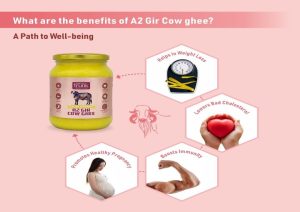
Can lactose intolerant people consume A2 Gir Cow ghee? When it comes to healthy and nutritious food options, A2 Gir cow ghee stands out as a true gem. Its unique properties and potential benefits have made it increasingly popular among health-conscious individuals. But what exactly are the benefits of A2 Gir cow ghee, and can those with lactose intolerance also enjoy its goodness? Let’s delve into this delicious dairy product and explore its wonders. Benefits of A2 Gir Cow Ghee: 1. Digestive Friendly: One of the remarkable features of A2 Gir cow ghee is its digestibility. Unlike regular ghee, A2 Gir cow ghee contains A2 beta-casein protein, which is believed to be easier to digest. It is known to soothe and promote a healthy digestive system, making it a favourable option for those with sensitive stomachs or digestive issues. 2. Nutrient Absorption: The consumption of A2 Gir cow ghee has been associated with improved nutrient absorption. It acts as a carrier for fat-soluble vitamins and minerals, allowing the body to better absorb these essential nutrients. Including A2 Gir cow ghee in your diet can help maximize the benefits of other nutrient-rich foods you consume. 3. Boosted Immunity: A2 Gir cow ghee possesses potential immune-boosting properties. It contains butyric acid, which has been linked to improved immune function. Regular consumption of A2 Gir cow ghee may help strengthen your body’s natural defence mechanisms and support a healthier immune system.
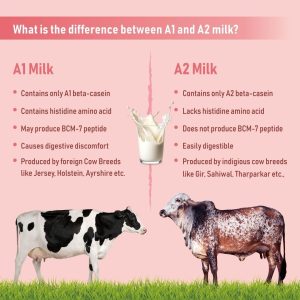
A1 and A2 milk refer to two different types of milk based on the genetic variation of beta-casein protein found in cow’s milk. The key difference lies in the presence of specific variants of the beta-casein protein called A1 and A2 beta-casein. A1 milk contains A1 beta-casein protein, which is a genetic variant found in the milk of certain breeds of cows, including Holstein Friesian, Jersey and Ayrshire. These breeds are commonly used in industrialized dairy farming. A2 milk, on the other hand, contains A2 beta-casein protein, which is the original variant of beta-casein protein found in milk. It is primarily associated with indigenous cow breeds like the Gir, Sahiwal, Kangrej, Ongole, Khillari, Tharparkar, etc,.
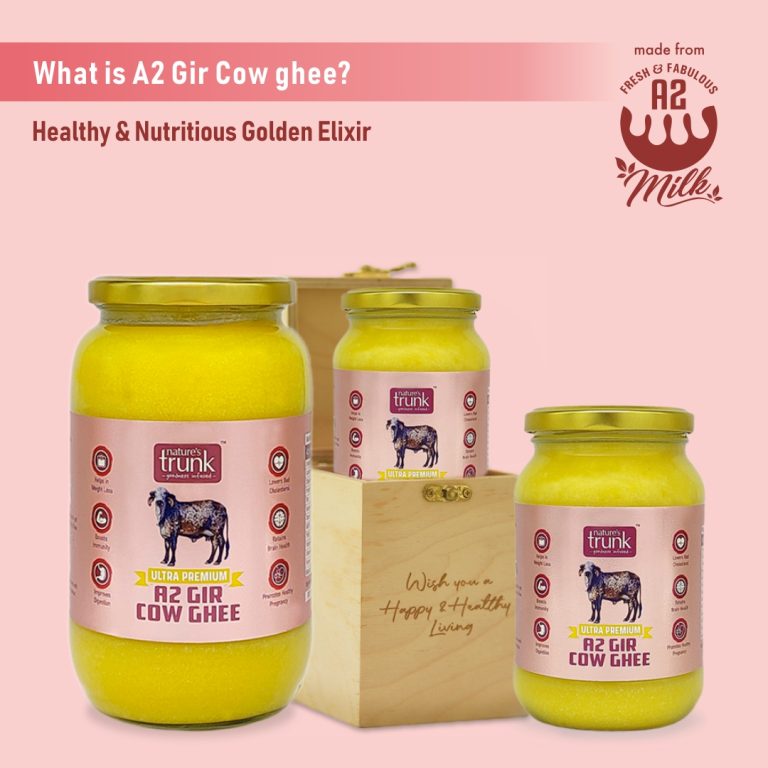
What is A2 Gir Cow ghee? A2 Gir Cow Ghee is a type of ghee that is derived from the fresh & pure milk of Gir Cows, an indigenous Indian breed known for its unique characteristics. Gir Cows are easily identifiable by their fascinating physical appearance round & domed forehead, distinctive large hump, long ears, twisted horns, prominent dewlap, long hairy tale, big udder and gentle temperament. These cows have been revered for centuries and are considered one of the oldest and most important indigenous cow breeds in India. What sets A2 Gir Cow ghee apart from other types of ghee is the type of milk used in its production. Gir Cows naturally produce A2 beta-casein protein in their milk, which is different from the A1 beta-casein protein found in the milk of hybrid foreign cow breeds. This distinction is based on the genetic variation of the cows’ beta-casein genes. The presence of A2 beta-casein protein in the milk of Gir cows is believed to be associated with several benefits. A2 beta-casein may be easier to digest and less likely to cause digestive discomfort compared to A1 beta-casein. It is thought that the digestion of A1 beta-casein can release a peptide called beta-casomorphin-7 (BCM-7), which may have adverse effects on some individuals. However, A2 beta-casein does not produce BCM-7, leading to the belief that A2 milk and ghee made from it are more suitable for consumption. To produce A2 Gir cow ghee, the milk obtained from Gir cows is typically processed using traditional methods passed down through generations. One such method is the Bilona process, which involves churning the curd made from A2 milk using a wooden churner. This process separates the butterfat from the buttermilk, and the butterfat is then heated on a gentle firewood flame until it transforms into ghee. The Bilona process is considered to be a time-honoured and labour-intensive method of ghee production. This process helps retain the ghee’s purity, nutritional content, and natural flavours. The slow heating on a firewood flame imparts a unique aroma and taste to the ghee, distinguishing it from ghee produced using modern methods. A2 Gir cow ghee is highly regarded for its rich flavour, golden colour, and aromatic qualities. It is valued not only for its culinary uses but also for its potential health benefits. It is rich in healthy fats, essential fatty acids, vitamins (such as vitamins A, D, E, and K), and minerals. Ghee is often used in traditional Ayurvedic practices and is believed to have various therapeutic properties.
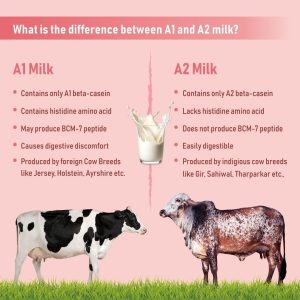
Difference between A1 and A2 milk: A1 and A2 milk refer to two different types of milk based on the genetic variation of beta-casein protein found in cow’s milk. The key difference lies in the presence of specific variants of the beta-casein protein called A1 and A2 beta-casein. A1 milk contains A1 beta-casein protein, which is a genetic variant found in the milk of certain breeds of cows, including Holstein Friesian, Jersey and Ayrshire. These breeds are commonly used in industrialized dairy farming. A2 milk, on the other hand, contains A2 beta-casein protein, which is the original variant of beta-casein protein found in milk. It is primarily associated with indigenous cow breeds like the Gir, Sahiwal, Kangrej, Ongole, Khillari, Tharparkar, etc,. The difference between A1 and A2 beta-casein lies in their amino acid composition. A1 Beta- Casein has a histidine amino acid at a specific position (position 67), whereas A2 beta-casein has a proline amino acid at the same position. During digestion, A1 beta-casein can be broken down into a peptide called beta-casomorphin-7 (BCM-7), which is believed to have certain effects on the human body. According to some studies, BCM-7 may interact with the opioid receptors in the digestive system and potentially contribute to discomfort and digestive issues in some individuals. These issues can include bloating, gas, and gastrointestinal distress. In contrast, A2 beta-casein does not produce significant amounts of BCM-7 during digestion. This has led to the belief that A2 milk might be easier to digest and less likely to cause digestive discomfort compared to A1 milk. It’s important to note that individual responses to A1 and A2 milk can vary, and not all individuals experience adverse effects from consuming A1 milk. Some people may tolerate both types of milk without any issues, while others may notice a difference in their digestion or overall well-being when consuming A2 milk.
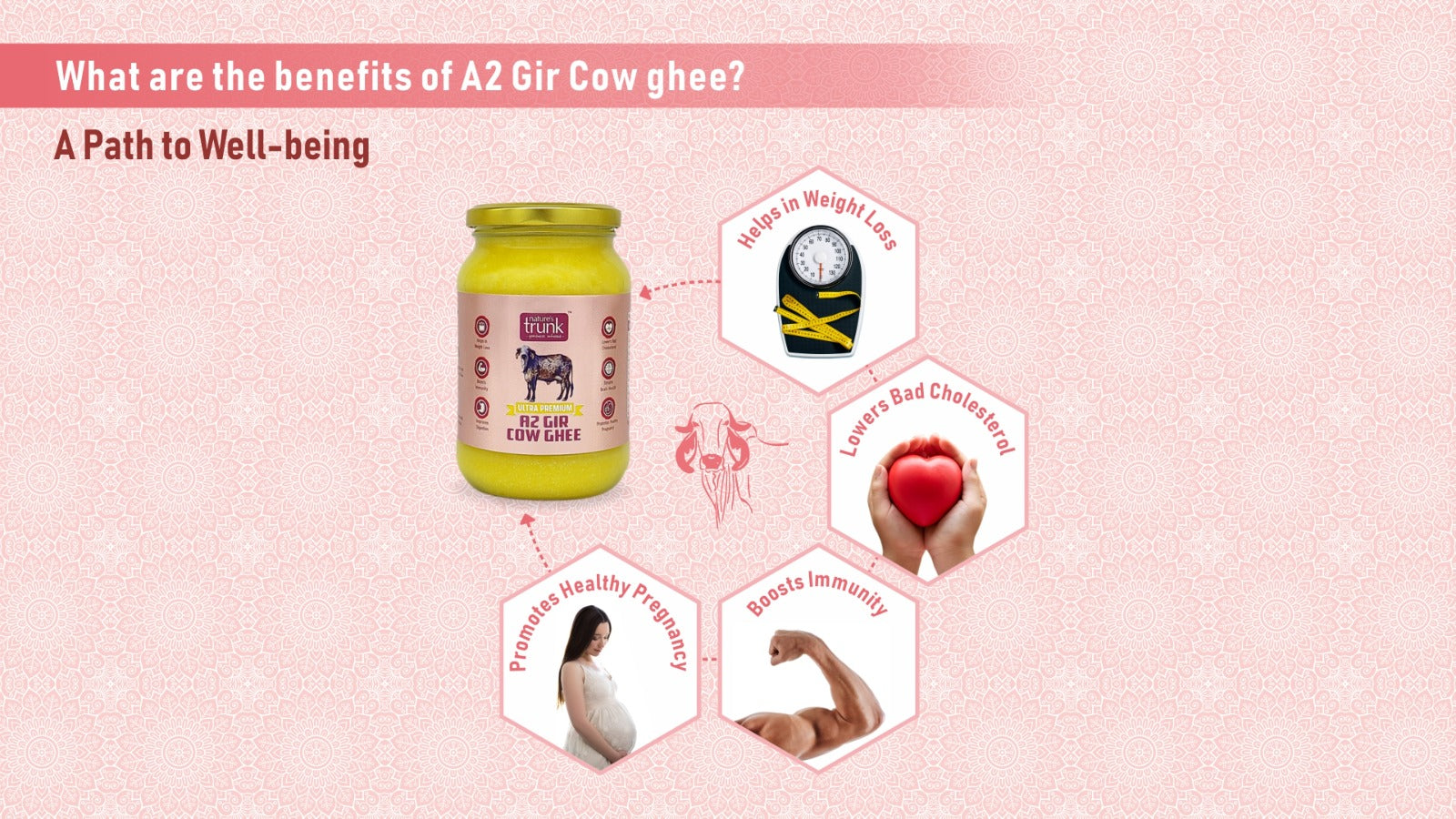
Can lactose intolerant people consume A2 Gir Cow ghee? When it comes to healthy and nutritious food options, A2 Gir cow ghee stands out as a true gem. Its unique properties and potential benefits have made it increasingly popular among health-conscious individuals. But what exactly are the benefits of A2 Gir cow ghee, and can those with lactose intolerance also enjoy its goodness? Let’s delve into this delicious dairy product and explore its wonders. Benefits of A2 Gir Cow Ghee: 1. Digestive Friendly: One of the remarkable features of A2 Gir cow ghee is its digestibility. Unlike regular ghee, A2 Gir cow ghee contains A2 beta-casein protein, which is believed to be easier to digest. It is known to soothe and promote a healthy digestive system, making it a favourable option for those with sensitive stomachs or digestive issues. 2. Nutrient Absorption: The consumption of A2 Gir cow ghee has been associated with improved nutrient absorption. It acts as a carrier for fat-soluble vitamins and minerals, allowing the body to better absorb these essential nutrients. Including A2 Gir cow ghee in your diet can help maximize the benefits of other nutrient-rich foods you consume. 3. Boosted Immunity: A2 Gir cow ghee possesses potential immune-boosting properties. It contains butyric acid, which has been linked to improved immune function. Regular consumption of A2 Gir cow ghee may help strengthen your body’s natural defence mechanisms and support a healthier immune system. 4. Heart Health: A2 Gir cow ghee is rich in healthy fats, including monounsaturated and polyunsaturated fats. These fats have been associated with improved heart health by helping to reduce bad cholesterol levels and promote good cholesterol levels, thus reducing the risk of heart diseases. 5. Anti-Inflammatory Properties: A2 Gir cow ghee contains anti-inflammatory compounds like butyric acid, which has been shown to have anti-inflammatory effects on the body. Incorporating A2 Gir cow ghee into your diet may help alleviate inflammation and related conditions. 6. Joint Health: The presence of omega-3 fatty acids in A2 Gir cow ghee contributes to its potential benefits for joint health. Omega-3 fatty acids are known to reduce joint stiffness, promote joint lubrication, and help alleviate symptoms of arthritis. 7. Weight Management: Contrary to popular belief, moderate consumption of A2 Gir cow ghee can aid in weight management. Its healthy fats and high nutrient content help provide a feeling of satiety, reducing cravings and overeating. 8. Skin and Hair Health: A2 Gir cow ghee contains essential fatty acids and vitamins like vitamin E, which can nourish the skin and hair from within. Regular consumption of A2 Gir cow ghee may contribute to healthier skin, improved moisture retention, and lustrous hair. 9. Cognitive Function: The presence of omega-3 fatty acids, along with other nutrients in A2 Gir cow ghee, may support brain health and cognitive function. These nutrients play a vital role in maintaining optimal brain function and may help protect against age-related cognitive decline. 10. Traditional Ayurvedic Benefits: A2 Gir cow ghee has been valued in Ayurveda for its various therapeutic properties. It is believed to balance dosas, support digestion, enhance vitality, and promote pregnancy and overall well-being according to Ayurvedic principles. Aside from its health benefits, A2 Gir cow ghee also offers a rich and distinct flavour. Its nutty and aromatic profile adds depth and complexity to a variety of dishes, making them more enjoyable and appetizing. From traditional Indian recipes to modern culinary delights, A2 Gir cow ghee can be the secret ingredient that elevates your cooking. Can Lactose Intolerant People Consume A2 Gir Cow Ghee? Lactose intolerance is caused by the body’s inability to digest lactose, a sugar found in milk and dairy products. However, the lactose content in ghee is typically minimal, as it is primarily composed of fat. During the clarification process involved in making ghee, most of the milk solids, including lactose, are removed, resulting in a product with very low lactose levels. This means that many people with lactose intolerance can often tolerate and enjoy A2 Gir cow ghee without experiencing the usual digestive discomfort associated with lactose-containing dairy products. However, individual tolerances may vary, so it’s essential to listen to your body and make decisions accordingly. As always, if you have severe lactose intolerance or any concerns, it’s best to consult with a healthcare professional or a registered dietician who can provide personalized advice based on your specific dietary needs.
There is nothing in your cart lets add some items.


Subtotal ₹0.00
Shipping Charges Calculated on checkout


